Tel Aviv, Israel – (ARAB NEWSWEIRE) —
1. Introduction: In the rapidly evolving landscape of corporate communications, the dissemination of information is just as critical as the information itself. For businesses, non-governmental organizations, and governmental bodies operating within Israel and the broader Middle East, press release distribution is a fundamental strategy for branding, reputation management, and targeted sales. However, the success of a public relations (PR) campaign is not solely dependent on the quality of the narrative or the prestige of the distribution platform. The relevance of timelines—encompassing the specific time of day, the day of the week, advance lead times, and regional calendar variations—is a critical factor that can make or break media pickup. When utilizing specialized platforms such as Arab Newswire, understanding and manipulating these timelines is essential for maximizing visibility across the Middle East and North Africa (MENA) region.
The Middle East and Israel present a highly unique media ecosystem. Unlike Western markets with relatively uniform workweeks and holiday schedules, this region is a mosaic of different cultural rhythms, religious observances, and business weeks. A press release sent without regard to the local timeline is likely to be buried in crowded inboxes, ignored by busy editors, or completely missed by journalists observing local weekends. Therefore, mastering the chronological aspect of PR distribution is a non-negotiable skill for modern communication professionals. This essay comprehensively explores the strategic relevance of timelines in press release distribution within Israel and the Middle East, specifically contextualized through the services and capabilities of Arab Newswire.
- The Ecosystem of Arab Newswire and Distribution Mechanics
To understand the importance of timing, one must first understand the vehicle of distribution. Arab Newswire is a commercial newswire service tailored specifically for distributing press releases to media outlets across the Gulf Cooperation Council (GCC) countries, the Levant, North Africa, and the broader Arab world. The platform caters to organizations budgeting for either low-tier PR plans aimed at general branding or high-tier plans designed to reach specific target audiences and generate precise sales outcomes.
When engaging with Arab Newswire, the distribution timeline is an integrated part of the service package. The turnaround time for press release distribution campaigns—whether utilizing their Basic, Standard, or Premium distribution packs—is typically five to six days. While Arab Newswire occaisionally distributes press releases within 24-48 hours, this built-in processing window means that PR professionals cannot simply submit a release and expect instantaneous publication across 150+ outlets; campaigns must be planned with this 5–6-day lead time in mind.
Furthermore, once the distribution is successfully completed, Arab Newswire actively monitors the media coverage for five days to compile and provide a clipping report featuring live links to the published content. This post-distribution monitoring timeline is vital for PR teams to assess the immediate impact of their news. Arab Newswire distributes content in Arabic, English, French and Turkish, reaching editors, journalists, and news outlets in up to 16 countries, including the UAE, Saudi Arabia, Jordan, Lebanon, and Egypt. Because the network is vast, coordinating the exact moment this distribution hits journalist inboxes across varying time zones is paramount.
- The “Golden Window”: Optimal Times of the Day
The most granular and arguably most impactful element of press release timelines is the time of day the release is deployed. Journalists across Israel and the Middle East, much like their global counterparts, manage relentless influxes of emails. The time of day a release is sent can determine whether it is read or deleted.
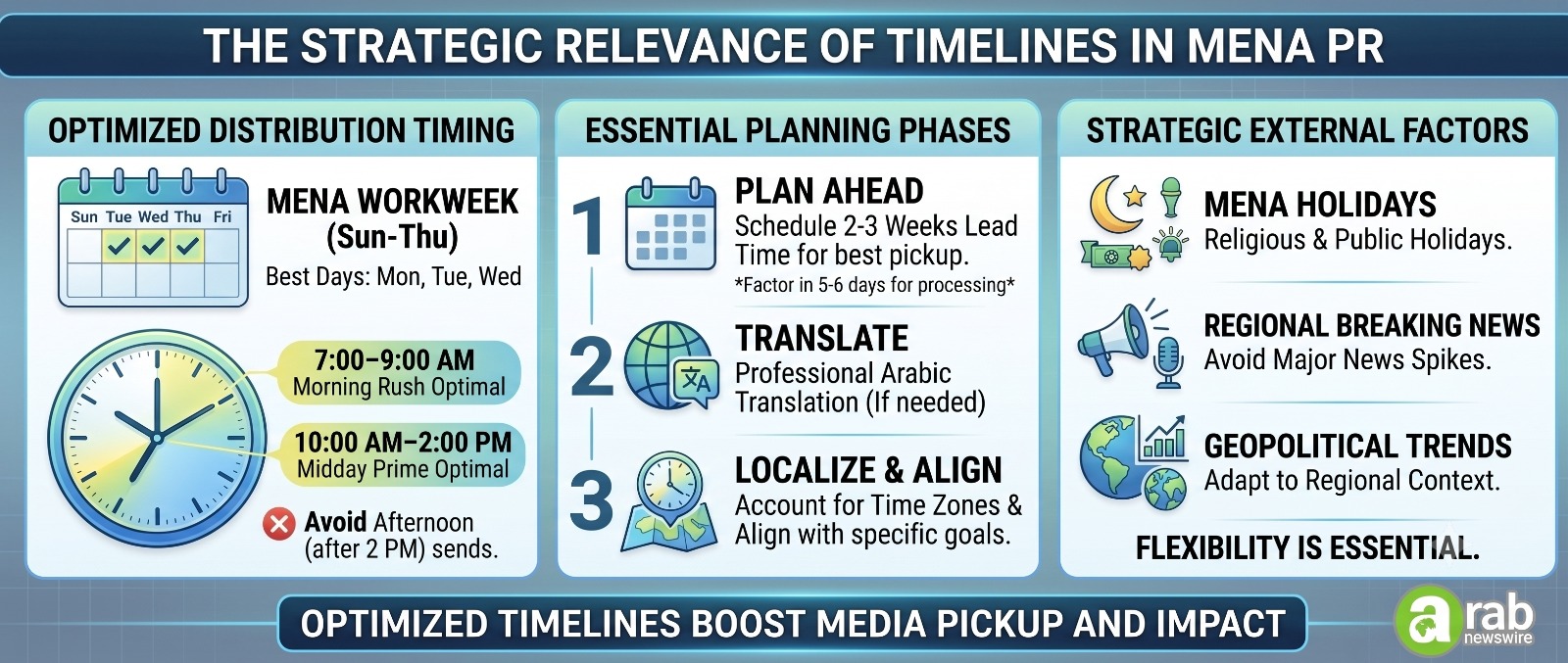
Research indicates that the best time to send a press release is generally in the morning, specifically between 7:00 am and 9:00 am. During these early morning hours, journalists are frequently checking their emails as part of their morning routine, making them significantly more receptive to new story pitches. In fact, studies show that 61% of journalists prefer receiving pitches in the morning. By landing in an inbox during this window, a press release avoids the midday rush and positions itself as potential content for the day’s editorial agenda.
Another highly effective block of time is the “golden window” between 10:00 am and 2:00 pm. Sending an email just before lunchtime is a strategic move that ensures the release is seen before journalists take their midday break. Conversely, the afternoon must generally be avoided. Open rates for press releases tend to fall off significantly after 2:00 pm, as reporters experience an “after lunch slump” and shift their focus toward finalizing stories, meeting deadlines, or attending late-day meetings. Sending a press release at 4:00 pm is often considered a wasted effort, akin to shouting into a void.
A critical nuance in scheduling is avoiding the top of the hour. Countless PR agencies and automated marketing systems schedule their blasts for exactly on the hour or half-hour (e.g., 7:00 am, 8:30 am, or 10:00 am). To stand out and prevent a press release from being bundled with this automated deluge, PR professionals should use unique send times, such as 8:17 am, 9:46 am, or 10:07 am. This minor chronological tweak is a highly effective tactic for enhancing visibility and reducing direct inbox competition.
- Navigating Time Zones Across the Middle East and Israel
When utilizing Arab Newswire to reach an audience spanning 16 countries—from Morocco in the west to Oman in the east—time zone management is a logistical necessity. The golden rule of press release distribution is to schedule the send based on the recipient’s local time.
If a company based in New York is utilizing Arab Newswire to target the United Arab Emirates and Saudi Arabia, they cannot send the release at 9:00 am Eastern Standard Time, as it will arrive late in the afternoon or evening in the Gulf, a time when journalists are winding down. The schedule must be adjusted to coincide perfectly with the local morning hours of the target journalists.
The Middle East spans multiple time zones. A synchronized campaign must account for these variations. If the news is specifically relevant to the Levant (such as Jordan, Lebanon, or Israel), the distribution must be timed to 8:00 am in their specific time zone. If it is a broad MENA release, PR teams must find an overlapping window that serves as an acceptable morning hour for the majority of the region.
- The Days of the Week: Regional Workweek Variations
Just as the hour of the day dictates engagement, the day of the week is equally critical. Globally, the consensus among PR professionals is that the middle of the week—Tuesday, Wednesday, and Thursday—represents the optimal days for distributing a press release.
Tuesday is frequently cited as the single best day to send a release. By Tuesday, journalists have typically cleared their inboxes of weekend accumulation and are actively hunting for new stories to fill their editorial calendars. Wednesday also performs exceptionally well; productivity remains high, and the competition for inbox real estate is lower than at the beginning of the week. Thursday often boasts the highest average open rates, as reporters finalize their stories before the week concludes, though reply rates might dip slightly compared to Tuesday or Wednesday.
Conversely, Mondays and Fridays are notoriously difficult and generally considered the worst days for distribution. On Monday, journalists are overwhelmed with dozens or hundreds of emails that accumulated over the weekend; in their rush to clear their inboxes, they often archive or delete less urgent pitches. Mondays are also dominated by editorial alignment meetings, leaving little time for reviewing new PR pitches. Fridays are equally ineffective, as reporters are winding down their weekly tasks, resulting in significantly lower engagement rates. Sending a release on Friday, especially in the afternoon, is usually only advised if the organization is attempting to bury difficult or negative news, as the subsequent weekend news cycle softens the story’s immediate impact.
However, when applying these rules to Israel and the Middle East, communicators must adapt to the regional workweek. In Israel, and in many Arab nations, the standard workweek runs from Sunday to Thursday. Friday and Saturday constitute the weekend, owing to Islamic and Jewish religious observances. Therefore, the “Monday madness” experienced globally actually occurs on Sunday in the Middle East. Sending a press release on a Sunday morning to Israeli or GCC media will likely result in the release being buried in the post-weekend inbox purge. Similarly, the “Friday wind-down” experienced in the West actually occurs on Thursday afternoon in the Middle East.
Consequently, the optimal mid-week window shifts. For a purely Middle Eastern or Israeli distribution via Arab Newswire, Monday, Tuesday, and Wednesday become the prime targets. Understanding this regional timeline shift is an absolute prerequisite for successful PR operations in the MENA region.
- Lead Times and Campaign Preparation
Beyond the immediate day and hour of distribution, the broader timeline of PR campaign preparation plays a pivotal role in securing media coverage. How far in advance a release is distributed dictates how journalists can utilize the information.
For planned events, major corporate announcements, or product launches, public relations teams should distribute the press release two to three weeks in advance. This extensive lead time allows journalists to conduct background research, schedule interviews with key stakeholders, and prepare comprehensive features rather than simply copy-pasting a corporate statement. Conversely, if the press release is designed to comment on a trending topic or a sudden current event in the organization’s industry, it must be sent without delay to capitalize on the narrow window of immediate media relevance.
When working with Arab Newswire, this lead time must be factored into their operational timelines. Because Arab Newswire requires a 5-6 day turnaround time for distribution across their Basic, Standard, and Premium tiers, a company wishing to capture media attention for an event three weeks out must actually initiate the process with Arab Newswire nearly a month in advance. Failing to account for the platform’s processing time will result in the news arriving too late for long-lead publications.
Furthermore, preparation timelines must include the time required for translation. Arab Newswire distributes in Arabic, English, and French, but a release submitted only in English may need to be translated to ensure maximum penetration across the Levant, North Africa, and the Gulf. Factoring in translation services adds an additional layer to the pre-distribution timeline, requiring PR managers to finalize their copy days or weeks ahead of the target distribution date.
- External Factors: Holidays, News Cycles, and Crisis Communications
A masterfully scheduled press release—sent at 8:17 am on a Tuesday in the correct time zone—can still fail entirely if it collides with unfavorable external timelines.
First, communicators must be acutely aware of regional holidays. Sending a press release during the week of major holidays guarantees low engagement. During these periods, newsrooms run on skeleton crews and focus almost exclusively on holiday-themed content. In the Middle East, this means carefully avoiding distribution during the Holy Month of Ramadan, Eid al-Fitr, Eid al-Adha, and in Israel, during major local holidays. The optimal strategy is to plan the distribution for the first full working week after the holiday concludes.
Second, PR timelines must remain flexible enough to adapt to the wider news cycle. If the entire media landscape is focused on a massive breaking story—such as a global summit, a major election, a natural disaster, or profound geopolitical shifts—a standard corporate press release will be entirely ignored. During major political events or tragic incidents, media focus shifts exclusively to the crisis; delaying a press release is not only strategically necessary to avoid being drowned out but also demonstrates respect and prevents the brand from appearing insensitive.
Similarly, economic shifts dictate media attention. If the stock market experiences extreme volatility or significant changes, financial reporters will redirect all their attention to the macroeconomic situation. In such scenarios, waiting until the market stabilizes before distributing corporate news via Arab Newswire ensures the message receives the attention it deserves.
Finally, retail and seasonal timelines provide opportunities. For B2C companies operating in the Middle East, timing a press release to align with major shopping seasons can yield massive returns. Aligning product news with local retail festivals or regional shopping events requires syncing the PR timeline with consumer behavior patterns.
- Strategic Goal Alignment
The overarching timeline of a PR strategy must also align with the company’s financial and organizational goals. As noted in industry analyses, companies must determine whether they are using low-tier PR plans for general brand awareness or high-tier plans to drive specific sales outcomes.
If the goal is long-term branding, the exact timing of a single release may be slightly less critical than the consistent, scheduled drumbeat of regular press releases published across search engines like Google, Bing, and Yahoo. However, if an organization aims to achieve targeted outcomes and reach specific vertical industries, they often rely on top-tier, highly targeted distributions. In these high-stakes, high-tier distributions, every element of the timeline—from the 5-6 day Arab Newswire turnaround to the exact minute of the morning send—must be executed flawlessly to ensure the investment yields the desired return.
- Conclusion
In conclusion, the successful distribution of a press release in Israel and the Middle East is heavily reliant on mastering timelines. Utilizing a robust platform like Arab Newswire provides organizations with the necessary infrastructure to reach 16 countries and hundreds of media outlets. However, the human element of scheduling remains paramount.
Public relations professionals must meticulously plan around Arab Newswire’s 5-6 day processing window, target the 7:00 am to 9:00 am or 10:00 am to 2:00 pm golden windows, and utilize off-hour scheduling tactics like 8:17 am to bypass automated competition. Furthermore, they must adapt to the unique Sunday-to-Thursday workweek prevalent in the region, shifting their target days away from the global standard to align with local editorial rhythms. By respecting local time zones, avoiding major regional holidays, and navigating around macro-level news cycles, communicators can ensure that their press releases are not just distributed, but actually read, reported, and amplified across the Middle Eastern media landscape.